
Alexandra Piñeros Shields
Associate Professor, Heller School for Social Policy and Management, Brandeis University
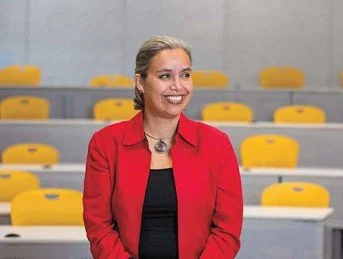
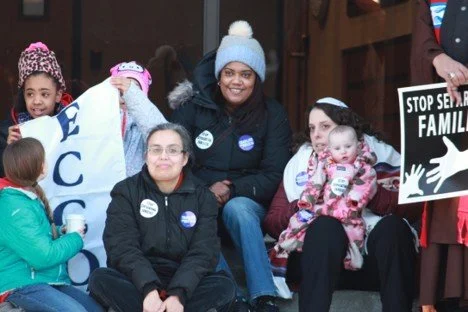
Alexandra at a Mothers Nonviolent Action at ICE.
The year was 1988, and the civil war in El Salvador was still raging. After four years of organizing on my college campus to stop U.S. intervention in that war, I joined the Jesuit Volunteer Corps and started working at the Central American Refugee Center (CARECEN) in Washington, D.C. as an immigration paralegal. At CARECEN, we focused on political asylum for refugees fleeing El Salvador. Most of our clients were denied asylum. As an example, although the threshold to win an asylum case is a “well-founded fear of persecution,” and my client Maria had a medical report by an INS-approved physician verifying she was a victim of torture, Maria was denied asylum. While I was learning the limits of the law, Maria, many of our clients, and thousands of others were organizing their communities to protest U.S. involvement in the war as well as U.S. immigration policies. Joining Maria in the nonviolent struggle for justice shaped my understanding of leadership and people power.
Since my days at CARECEN, I have worked to create spaces and processes where everyday people can step into their power, engage in democratic decision-making, and transform the oppression in their lives. The frameworks and strategies that I have co-designed with community groups and organizations have enabled us to implement practices of shared power. Our collective work has led to significant successes within organizations, across coalitions, as well as in the public sector, towards dismantling the systems of mass incarceration in the immigrant detention and criminal legal systems.
During my tenure as executive director of the Essex County Community Organization (ECCO) an interfaith, interracial, and interclass network of 40 congregations, I transformed the organization into one guided by womanist, antiracist and anti-imperialist democratic principles that centered Black and Latinos at all levels of decision-making. By centering the individuals most affected by systems of mass incarceration, ECCO leaders designed and led campaigns that produced impressive policy changes, such as the establishment of sanctuary policies in four cities, the institutionalization of community-driven implicit bias training for an entire police force, and the development of an unarmed crisis response team to respond to mental health emergencies instead of the police. One of the most important lessons I have learned as a community organizer is that my goal is always to imagine and nurture processes where people can exercise their innate power and experience life-giving belonging. As such, I understand my role to be that of a “Midwife for Power.”
At the statewide level, I served on Gov. Deval Patrick’s research design team for the New Americans Agenda, an executive order that produced an immigrant integration policy agenda for Massachusetts. I have worked at many immigrant-serving institutions, including the Massachusetts Immigrant and Refugee Advocacy Coalition (MIRA), the International Irish Immigrant Center, and Catholic Charities. Currently, I support the LUCE network as they build collective nonviolent resistance to immigration enforcement overreach.
I am an Associate Professor at the Heller School at Brandeis University, where I serve as the director of the Master of Public Policy program. I teach courses on immigration policy, economic democracy, and Community-driven Participatory Action Research. I served as Chair of the Board of the Massachusetts Budget and Policy Center for six years and currently serve on the board of directors of the ACLU of Massachusetts, Philanthropy Massachusetts, and the Right Question Institute.